

Table of Contents
- What Makes a Backpack for Women Travel Different
- How to Choose a Carry On Backpack for Women
- Best Laptop Backpack for Travel: Protection and Tech Integration
- How to Pack a Carry On Backpack Efficiently
- Durability, Materials and Sustainability: What Lasts
- Style vs. Functionality: Finding Your Balance
- Frequently Asked Questions
Last Updated: September 28, 2026
What Makes a Backpack for Women Travel Different
A backpack for women travel is a carry-on bag built around a shorter torso, narrower shoulders, and a lower center of gravity than standard unisex packs. That difference shows up in strap placement, back panel length, and how weight sits on your hips. This guide from TreasurTrove breaks down what actually matters before you buy.
Most backpacks are designed for a 19-inch torso. Many women measure 15 to 17 inches. When a pack is too long, the hip belt rides above your hip bones instead of resting on them, so your shoulders carry the load all day. That's the single biggest reason a "unisex" pack feels wrong on a female frame.
Here's the good news: getting this right is easier than it sounds. Below, we'll show you exactly which features to check, and the two we'd skip entirely.
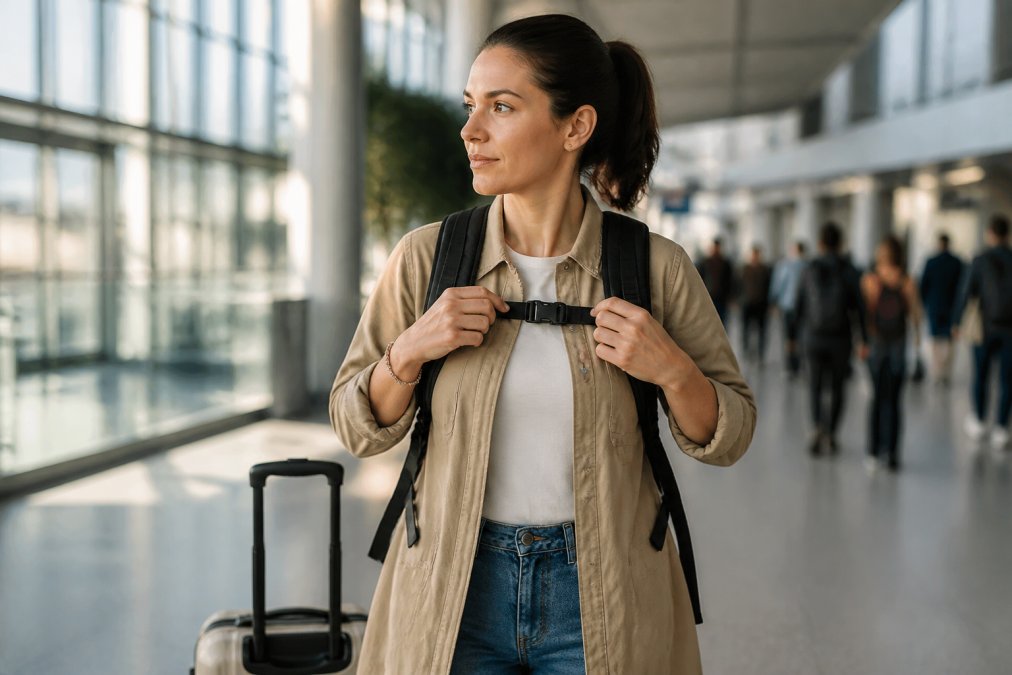
Ergonomic Straps and Weight Distribution for Female Frames
Ergonomic straps are curved shoulder straps that follow the natural slope of the shoulder, paired with a hip belt that transfers weight off your back. On a well-fitted women's pack, roughly most of the load should rest on your hips, not your shoulders.
Look for these four things:
- Contoured shoulder straps that curve inward rather than running straight
- A padded hip belt that sits on your hip bones, not your waist
- A sternum strap you can slide up or down to find your comfort point
- Load lifters (small straps at the top of the shoulders) to fine-tune the angle
A common mistake is buying a pack that fits your height but not your torso. Measure your torso first: from the bony bump at the base of your neck down to the top of your hip bones. That number, not your height, decides the size.
Security Features for Solo Female Travelers
Anti-theft features matter most when you're traveling alone. The basics worth paying for: lockable zippers, a hidden pocket against your back panel, and a slash-resistant base panel.
Where most packs fall short is the laptop compartment. It usually opens outward, facing away from you in a crowd. A pack with a rear-access laptop sleeve keeps your electronics against your spine, which is both safer and better for weight distribution.
How to Choose a Carry On Backpack for Women
The right carry on backpack for women fits your torso, meets your airline's size limit, and holds everything for a trip of your length. Get those three in order and you'll rarely regret the purchase.
Start with fit, then size, then features. Most shoppers do it backwards.
Carry-On Compliance and Airline Regulations
Carry-on compliance means your pack fits the overhead bin dimensions your airline allows. Most major carriers set a limit around 22 x 14 x 9 inches, but budget airlines often go smaller.
Before you buy, check your airline's published carry-on page directly. Dimensions change, and a bag that passes on one carrier can fail on another. The TSA guidance on what you can bring through security is also worth a look if you're unsure what counts as a personal item versus a carry-on.
A soft-sided pack has one real advantage here: it squishes. If a gate agent asks you to test it in the sizer, a soft bag compresses where a hardshell won't.
Capacity Requirements: 20L to 40L
Capacity in liters tells you how much the pack holds. For most trips, here's the practical breakdown:
| Capacity | Best For | Trip Length |
|---|---|---|
| 20-25L | Daypack, personal item | Day trips, under-seat only |
| 26-32L | Weekend trip, commuter | 2-3 days |
| 33-40L | Main carry-on | 4-7 days |
The trap is buying too much capacity. A 40L pack that's half empty still weighs what it weighs, and you'll fill the space just because it's there. If you fly budget carriers often, a 28-32L pack is the sweet spot.
Best Laptop Backpack for Travel: Protection and Tech Integration
The best laptop backpack for travel protects your device, opens flat for security checks, and keeps cables from becoming a knot. Padding alone isn't enough.
Laptop Compartment Security and Sizing
Laptop sleeve sizing should match your device, not exceed it. A 15-inch sleeve holding a 13-inch laptop lets the machine slide around, and corner impacts are what kill laptops.
Check three things:
- Suspension: the sleeve should sit off the bottom of the bag, not rest on it
- Padding thickness: thin foam is fine for a commute, not for overhead bins
- Access direction: rear-access is more secure, top-access is faster at security
USB Charging Ports and Tech-Friendly Design
USB charging ports built into a pack are convenient, but understand what you're buying. Most are pass-through ports: you supply the power bank, the bag supplies the cable routing. The pack itself doesn't store energy.
What actually earns its place is good cable management. Look for an internal mesh pocket with a port cutout, so your power bank stays put while your phone charges in an outer pocket.
How to Pack a Carry On Backpack Efficiently
Packing efficiently comes down to one rule: use the depth of the bag, not just the surface. Most people pack flat and waste half their capacity.
Packing Cubes, Shoe Pouches and Organization Systems
Packing cubes compress clothing into blocks you can pull out without unpacking the whole bag. Shoe pouches keep dirty soles away from clean clothes. Together they turn a chaotic 30L into a system.
Try this order:
- Heaviest items (shoes, toiletry bag) against the back panel, closest to your spine
- Packing cubes in the middle, stacked vertically if the bag opens flat
- Soft items (jackets, scarf) on the outer edge to cushion
- Small electronics in the top pocket for security lines
A luggage pass-through strap is worth having if you also travel with a rolling bag. It slides over the handle and keeps the pack off your shoulders in the terminal.
Durability, Materials and Sustainability: What Lasts
Durable travel packs use high-denier fabric, quality zippers, and reinforced stitching at stress points. The zipper is where cheap bags fail first.
Look for YKK-style zippers, bar-tacked seams at the strap anchors, and a waterproof coating or a rain cover. A breathable mesh back panel matters too: it keeps the pack off your spine and reduces sweat on long walks.
On sustainability, the honest answer is that fewer, better bags beat recycled marketing claims. A pack that lasts eight years is greener than three that last two each. Ask brands how they handle repairs before you buy.
Style vs. Functionality: Finding Your Balance
Aesthetic and function aren't opposites. The trick is deciding which one you'll compromise on when they conflict.
A hardshell vs softshell choice is the clearest example. Hardshells protect better and look sharper, but they don't compress and they're heavier empty. Softshells squish into overhead bins and fit more, but offer less crush protection.
What most reviews miss is that versatility is the real prize. A pack that looks clean enough for a work trip and holds up on a weekend hike earns its cost. One that only works for one scenario sits in the closet.
For a daypack you'll carry around town, prioritize light weight and a slim profile. For a travel-ready main bag, prioritize the hip belt and load lifters. Trying to make one bag do both usually means it does neither well.
At TreasurTrove, we curate bags that balance style and function, so you're not choosing between looking good and packing smart.
Frequently Asked Questions
What are some good backpacks for women to use on flights?
Look for a women travel backpack with a padded back panel, ergonomic straps, and a sternum strap to distribute weight evenly. A 30-40L capacity fits most airline carry-on limits, and a dedicated laptop sleeve keeps electronics secure. Breathable mesh on the back panel helps with comfort during long travel days. Check that the bag is carry-on compliant with major US airlines before buying.
Does TSA allow backpacks as carry-on?
Yes, TSA allows backpacks as carry-on luggage. There is no rule against backpacks specifically, but your bag must fit within your airline's size limits, typically around 22 x 14 x 9 inches. Liquids must follow the 3-1-1 rule and electronics may need to be removed at security. A carry on backpack for women with a quick-access laptop compartment makes the screening process faster.
How do I choose the right size backpack for air travel?
Start by checking your airline's carry-on dimensions. Most US carriers allow bags up to 22 x 14 x 9 inches. For a weekend trip, 20-30L works well; for longer trips, 35-40L offers more space without exceeding limits. Consider how to pack a carry on backpack efficiently with packing cubes to maximize every liter. A bag that fits under the seat is ideal for personal item use.
What features should a women's travel backpack have for laptop protection?
A padded laptop sleeve sized for 13-16 inch devices is essential. Look for a separate tech compartment with a false bottom to protect against drops, plus a tablet pocket and cable organizers. Waterproof or water-resistant zippers add security in rain. For the best laptop backpack for travel, prioritize padded back panels and adjustable straps so the weight stays comfortable even when the bag is fully loaded.
Choosing a backpack for women travel comes down to fit first, features second. A pack that matches your torso length and hip shape will outperform a more expensive one that doesn't. TreasurTrove handpicks bags and travel gear with fair, sensible pricing, a focus on quality and style, and a 10% discount on your first order. Get started with TreasurTrove and find a pack that carries well from the gate to the trail.


